BridgeQMT4/MT5 Liquidity Bridge for Forex Brokers
The forex liquidity bridge that connects your MT4 and MT5 platforms to any liquidity provider over FIX — point-level A/B-book routing control, aggregated multi-LP pricing and real-time execution monitoring, all from a single dashboard. Includes Copilot, a built-in AI assistant that drafts policy and routing changes from plain-language requests for an admin to review and approve.
See every order, every millisecond
The dashboard streams requests/sec, p50/p99 latency, A-book share and a live feed of recent executions by platform, login and symbol — so the dealing desk sees exactly what is happening without digging through logs.
- Live bridge-flow map: MT4/MT5 platform → gateway core → liquidity provider
- p50 / p99 latency and request-volume charts, updated by the second
- Recent-executions feed with verdict (Execute/Reject) and fill result

What is a forex liquidity bridge?
A forex liquidity bridge is the software between a broker's MetaTrader server and its liquidity providers. It streams LP prices into the platform, sends client orders to the LPs or keeps them in-house according to the broker's rules, and returns the fills. BridgeQ does this for MetaTrader 4 and MetaTrader 5 over FIX 4.3 / 4.4, with any number of providers behind a single bridge.
Connects MT4 & MT5 to your LPs
Separate FIX market-data and order-entry sessions per provider, added by configuration rather than code.
Routes every order
A-book, B-book or blended, decided per account group, symbol, size and time by ordered policy rules.
Aggregates the price
Depth from every LP merged into one VWAP book, then published per platform with its own markup.
Liquidity bridge pricing: fixed vs. volume-based
| Typical volume-based bridge | BridgeQ | |
|---|---|---|
| Price model | Monthly fee plus a commission per million traded | Fixed, starting at $1,000/month |
| As your volume grows | Cost grows with it | Cost stays the same |
| Cut of your flow | Yes, per traded volume | None |
Read our complete guide to forex liquidity bridges for MT4/MT5 brokers →
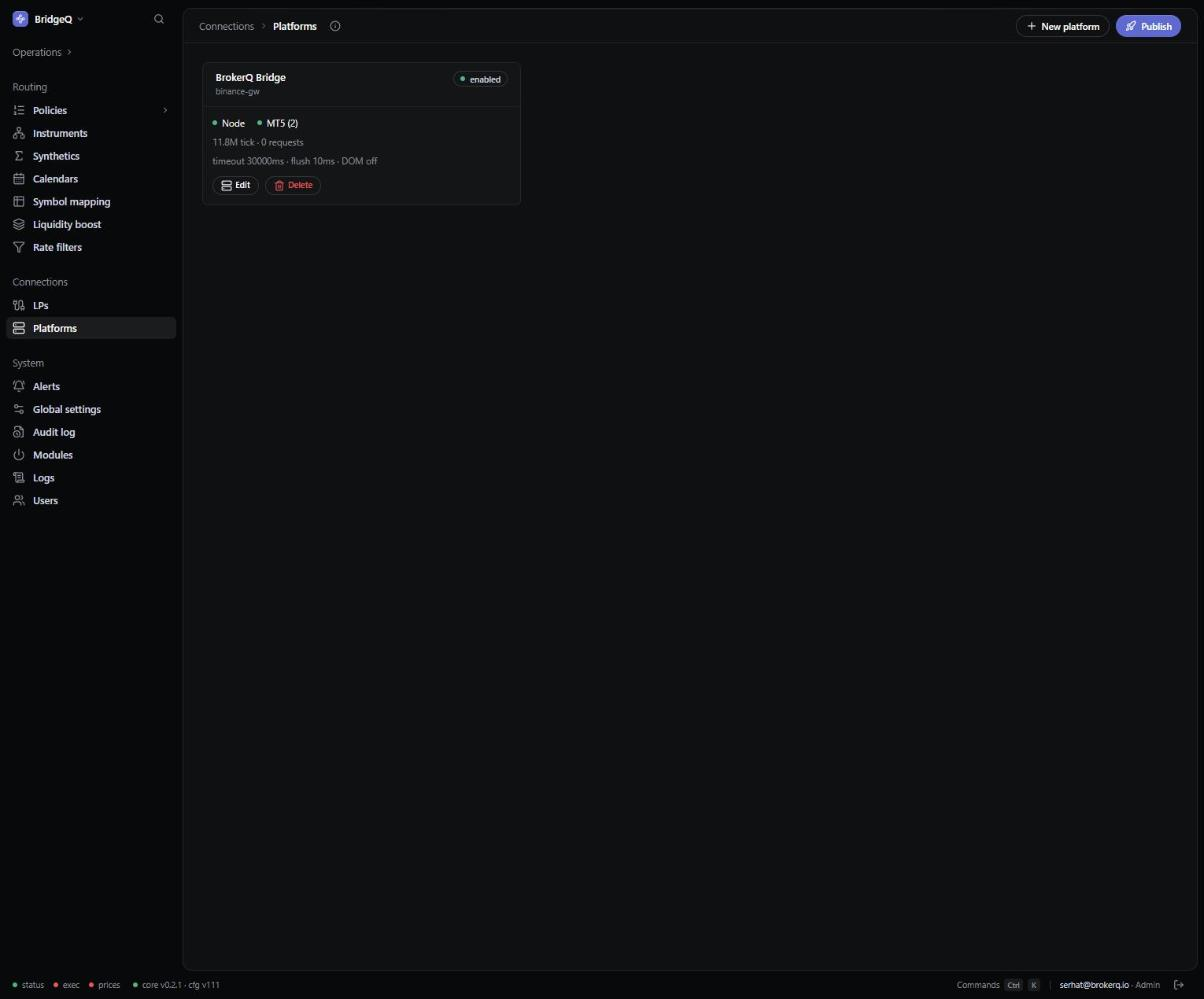
One bridge, every liquidity provider
FIX market-data and order-entry sessions to Binance, Integral, MatchTrader and more are aggregated behind a single bridge to your MT4 and MT5 platform nodes.
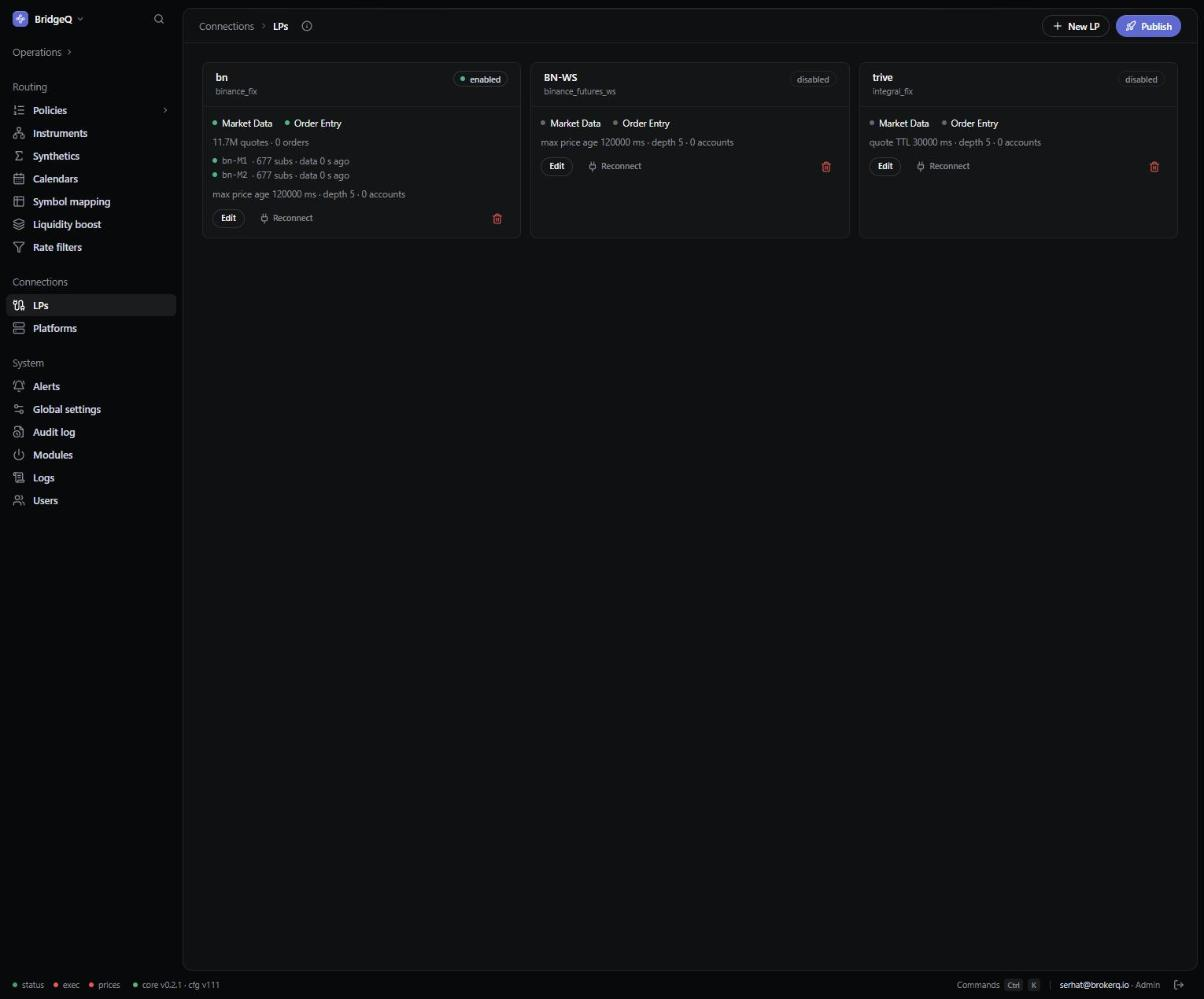
One aggregated price, published your way per platform
Depth from every connected LP is merged into a single VWAP book, then each MT4 or MT5 platform can republish that same book under its own symbol with its own markup.
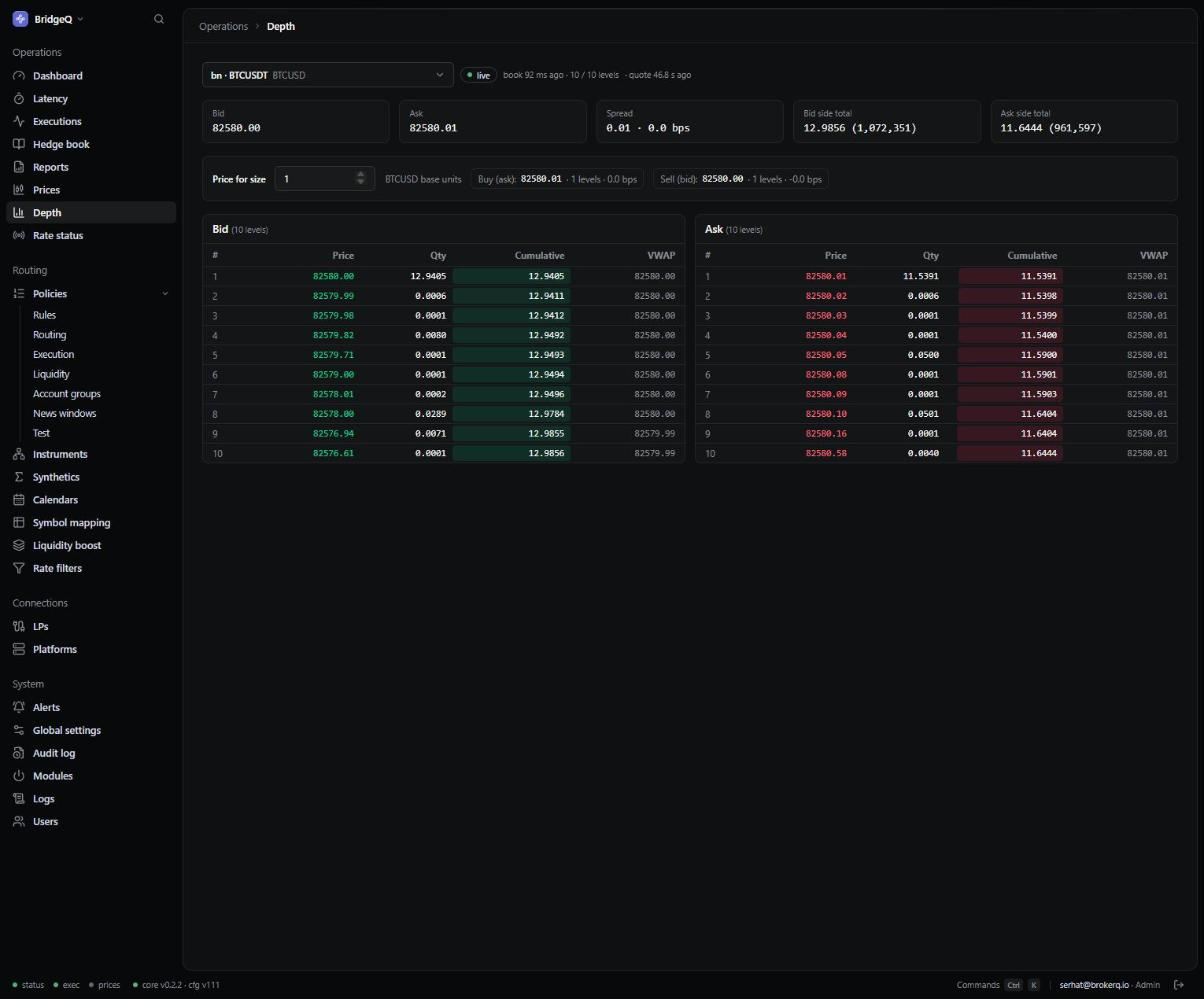
Aggregated depth, not one feed
Every connected LP's order book is combined into one VWAP price per symbol, with a configurable response to a liquidity shortfall.
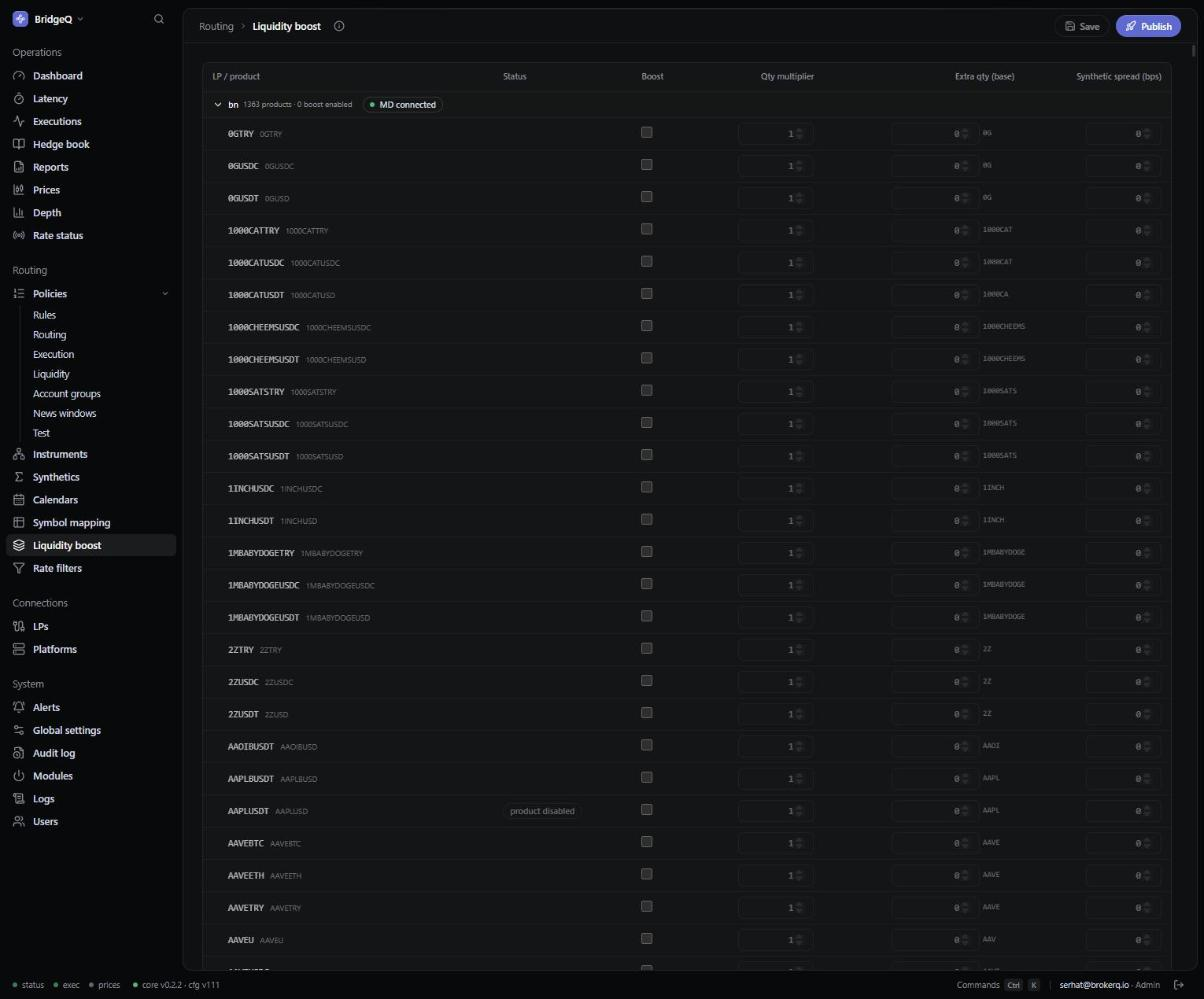
Boosted where it's thin
A quantity multiplier, extra synthetic quantity and a synthetic spread can thicken the book per LP and product, independent of what the LP actually quotes.
Same price, different markup per platform
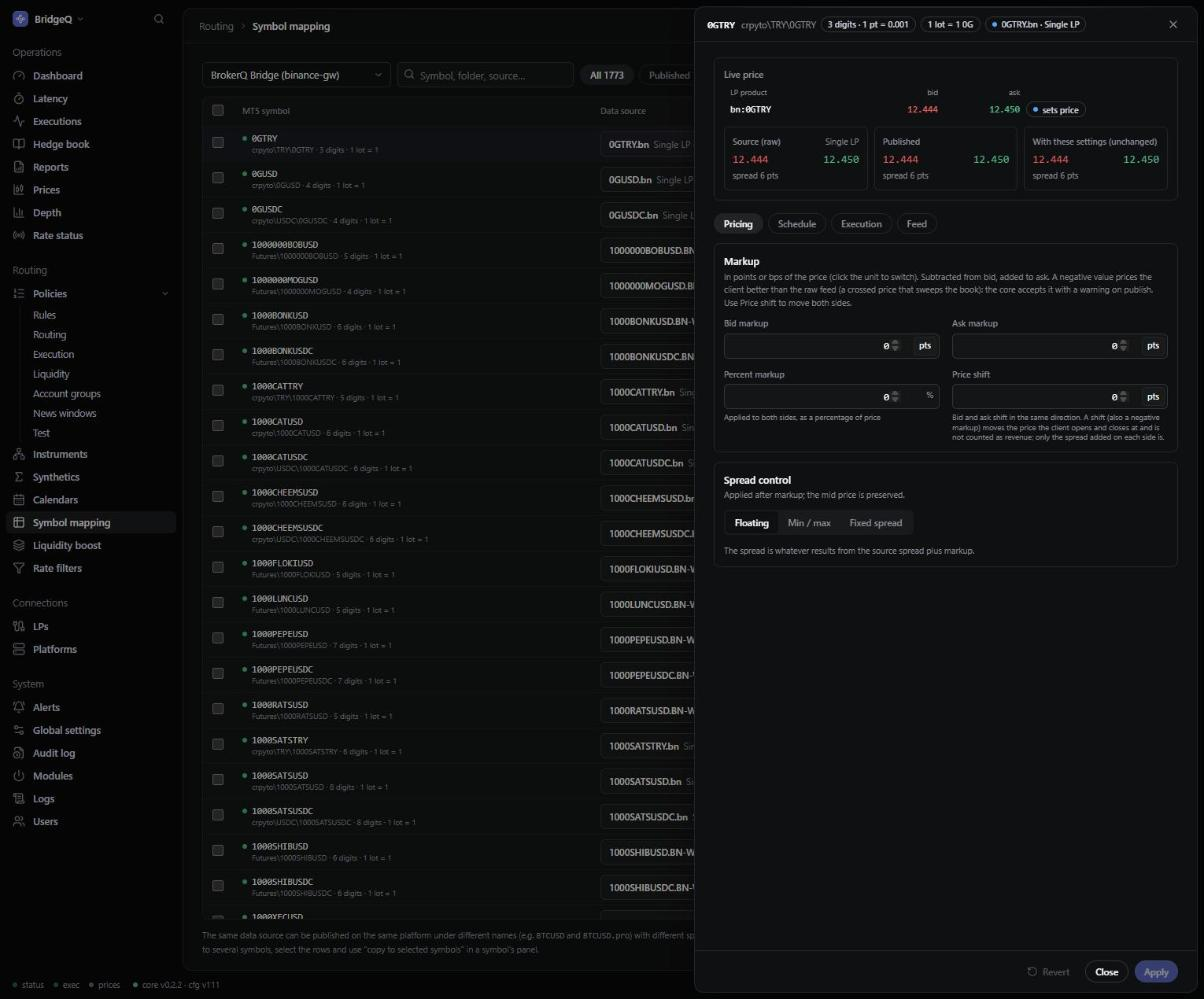
The same underlying symbol mapping can be published to several MT4 and MT5 platforms, each under its own name with its own pricing — so a grey-label brand and your main platform can sell the same liquidity at a different spread.
- Bid / ask markup or a single percent markup, in points or bps
- Price shift moves both sides together without changing the spread
- Spread control: floating passthrough, min/max clamp, or a fixed spread
Rules compose — they don't just override
Each rule can decide routing, execution and liquidity independently. Leave a kind empty and it passes down to the next matching rule, so simple, narrow rules combine instead of needing one giant rule per case.
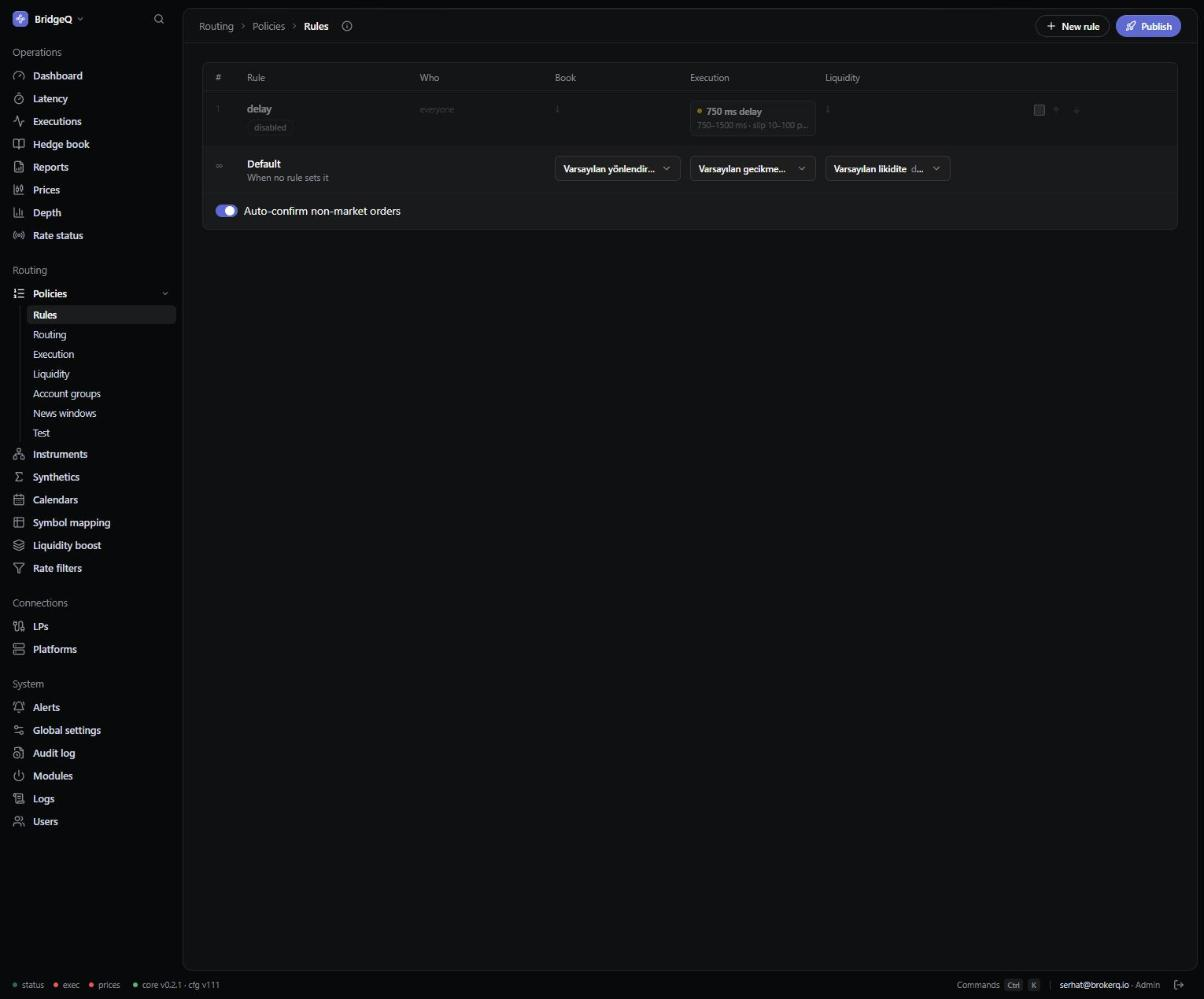
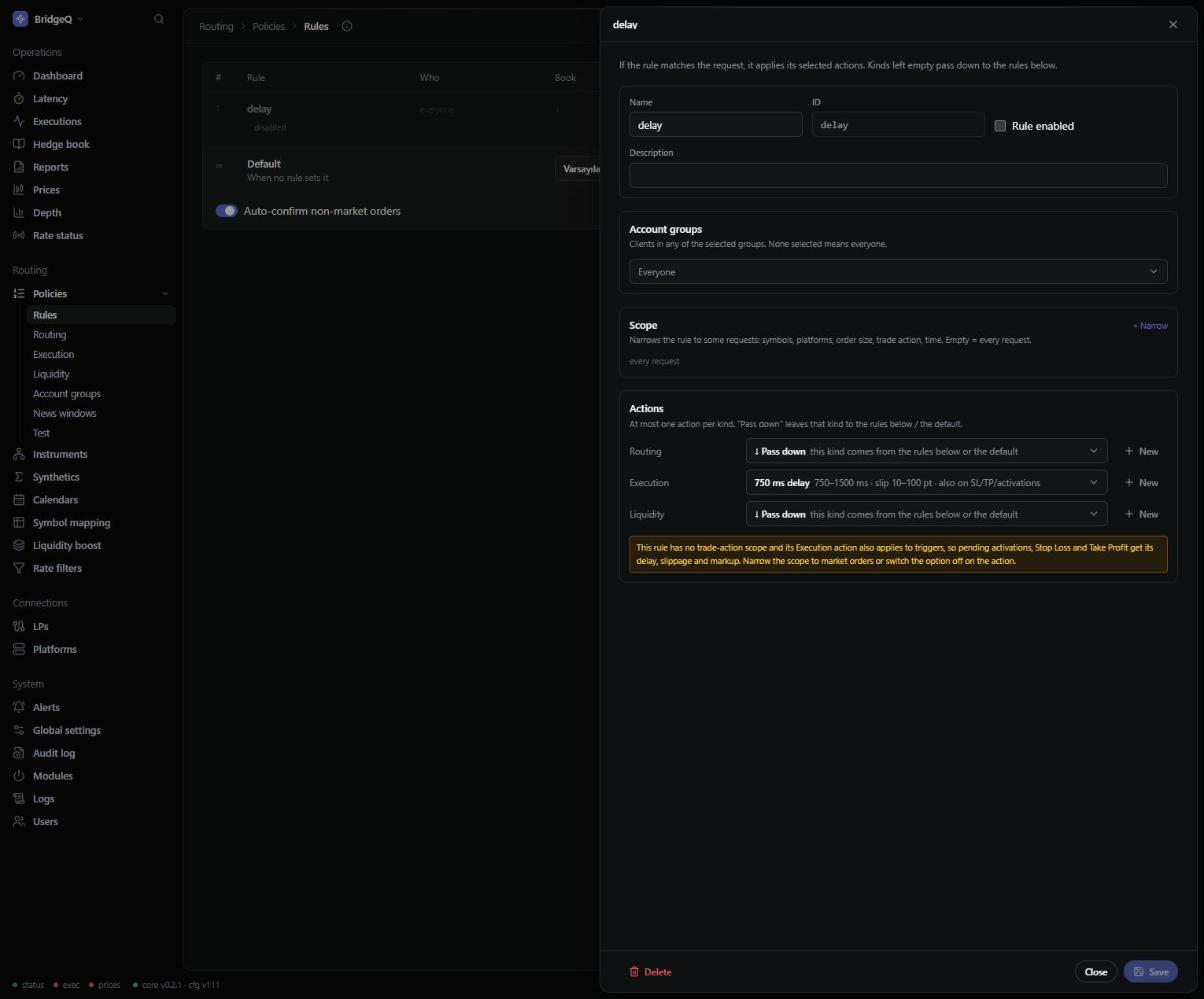
How a rule is evaluated
Order arrives
Any request — market, pending, SL/TP — enters the policy engine.
Rule matches?
Checked in priority order: account group + scope (symbol, platform, size, time).
Apply its actions
Routing, Execution and Liquidity are set independently per rule.
Default policy
Whatever no rule decided falls back to the global default action for that kind.
Two rules from this config
Demo accounts
group matches demo\*
VIP crypto, ≥ 0.5 lot
group matches real\VIP*
Control down to the point, not just A-book or B-book
A routing action is more than a book switch: it sets exactly how much worse price is tolerated on a market-if-touched order and how much price improvement, if any, is passed on to the client — tuned per rule, not left to a blunt on/off toggle.
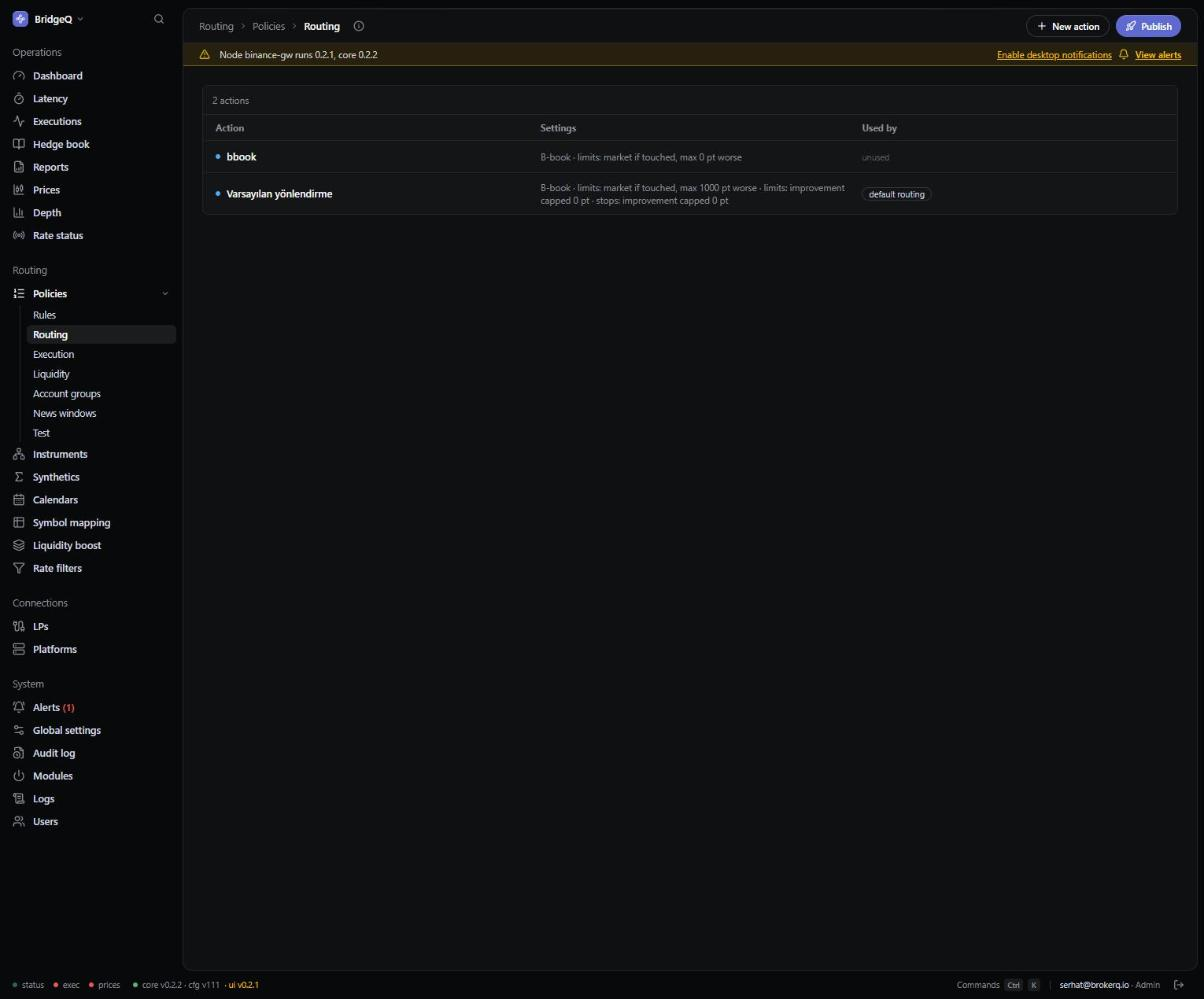
- Set the book (A or B) independently from the price-improvement policy
- Cap how many points worse a market-if-touched fill is allowed to be
- Decide whether — and how much — improvement on limits and stops reaches the client
- Reuse the same named action across many rules, or give each one its own
Two routing actions from this config
bbook
No slippage either direction — the client gets exactly the quoted price.
Default routing
Market-if-touched tolerates up to 1000pt worse, but no price improvement is passed through.
And if the LP can't fill it
The same precision still holds when something goes wrong — a reject, timeout, disconnect or rate-limit falls straight back to B-book instead of leaving an order stuck.
Order routed to the LP (A-book)
Sent to the configured liquidity provider for execution.
Filled by the LP
Normal path — the provider accepts and fills the order.
Reject · timeout · disconnect · rate-limited
Any of these trips the fallback — instantly and automatically.
Falls back to B-book
Filled internally with no client-visible disruption.
Ask for the change in plain language. Review the diff. You decide.
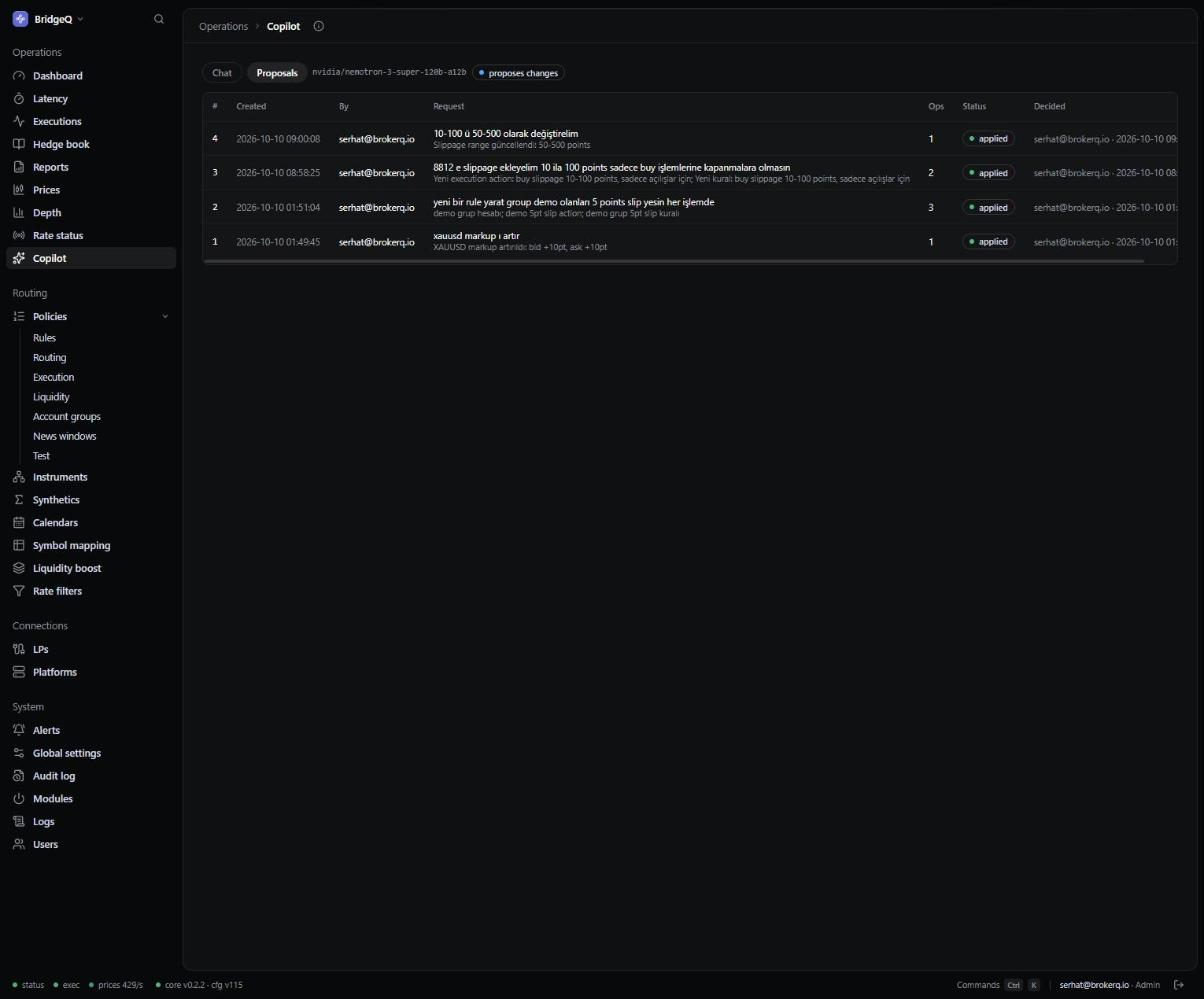
Copilot is a built-in assistant that reads your live policy, routing and pricing configuration through the same APIs the dashboard uses — in any language. Ask it a question or describe a change, and it stages a reviewable proposal instead of touching anything itself.

Ask in your own words
"8812'ye slippage ekleyelim, 10-100 points, sadece buy islemlerinde" — Copilot reads straight through natural language, in whatever language you write it.
Staged as a diff, not applied
It looks up the current policy, pricing and routing, then proposes an old-value to new-value diff for review — nothing changes yet.
Admin approves, then it publishes
Only after an admin applies the proposal does it go live, versioned (e.g. v114 to v115) with the approver and timestamp recorded.
Nothing is silent
Every question Copilot answers and every proposal it stages is written to the same audit log as a manual change — so a request in chat is exactly as traceable as a click in the dashboard.
Read how we think AI copilots for broker infrastructure should be built →
At a glance
- Pricing
- Starting at $1,000/mo — fixed price, independent of trading volume
- Protocol
- FIX 4.3 / FIX 4.4
- Architecture
- Gateway core + per-platform node process
- Routing Models
- A-book, B-book or blended, with per-action worse-price limits and price-improvement caps
- Aggregation
- VWAP across all connected LP depth, with per-LP quantity boost and synthetic spread
- Symbol Markup
- Per-platform bid/ask markup, percent markup, price shift and spread control (floating, min/max, fixed)
- Access Control
- Role-based — Admin, Dealer, Viewer — via SSO
- Safety
- One-click kill switch, real-time latency & exposure alerts
- Copilot
- Natural-language assistant that stages policy, routing and pricing changes as a reviewable diff — published only after admin approval
Frequently asked questions
A forex liquidity bridge is the software layer between a broker's trading platform and its liquidity providers. It streams LP prices into the platform, sends client orders out to the LPs (A-book) or keeps them in-house (B-book) according to the broker's rules, and returns the fills — so the broker can offer external liquidity without wiring each provider into MetaTrader separately. BridgeQ is a liquidity bridge for MetaTrader 4 and MetaTrader 5 that connects over FIX 4.3 / 4.4.
Related Solutions
Explore other tools that work alongside BridgeQ.
Ready to get started?
Schedule a demo and see BridgeQ in action.